
The export of Portuguese natural stone to international markets represents a strategic opportunity for contemporary architecture and construction. However, when applied to projects outside its country of origin, natural stone faces a central challenge: transportation. Weight, handling, and safety throughout long logistics routes become decisive factors in the technical and economic viability of each project.

Honeycomb:
The Solution for Transporting Natural Stone
International transport of natural stone involves complex logistics chains, often combining road and maritime transport with intermediate loading and unloading operations. In the case of solid stone, the high weight per square metre limits the amount of material per container, increases energy consumption, and requires specialised lifting equipment.
During transport, continuous exposure to vibrations, thermal variations, and mechanical impacts can compromise the integrity of the material. Heavy and rigid slabs are more prone to cracking, edge breakage, and damage-related losses, which directly affect timelines, costs, and overall project predictability.
Honeycomb Solutions
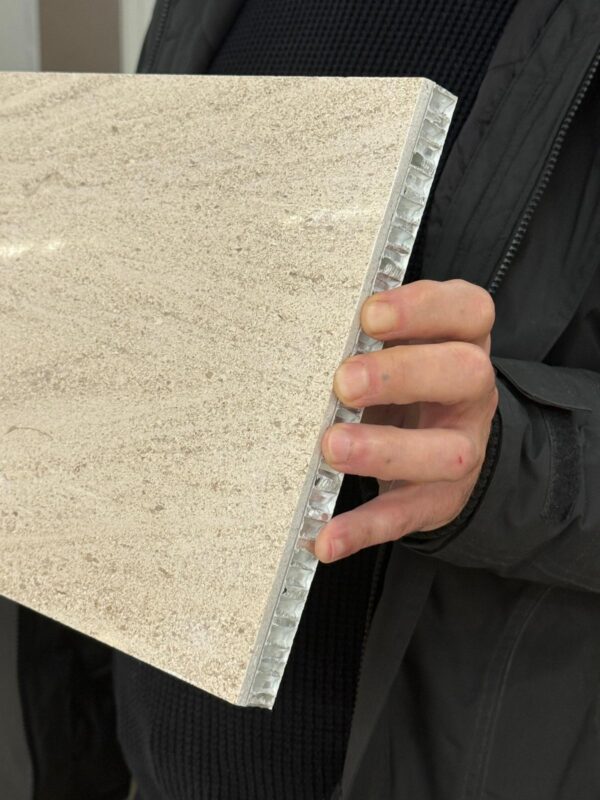
Natural stone with a honeycomb system emerges as a technical response to these logistical challenges. This solution combines a natural stone veneer with a technical honeycomb-structured core, ensuring high mechanical resistance with a significant reduction in weight.
From a transport perspective, this solution allows for optimised packing, reduced structural loads, and increased efficiency in container shipping. The honeycomb structure acts as a reinforcing and stress-absorbing element, protecting the natural stone from tensions caused by movement and vibrations throughout long transport routes.
A Solution Aligned with the Global Market
The adoption of honeycomb solutions allows Portuguese companies, such as Natstone, to strengthen the competitiveness of natural stone in global markets by combining tradition, innovation, and sustainability.
By significantly improving logistical performance and simplifying on-site application, this technology expands the potential of natural stone in façades, interior cladding, and high-demand architectural projects, while preserving the timeless beauty and quality of Portugal’s natural materials.